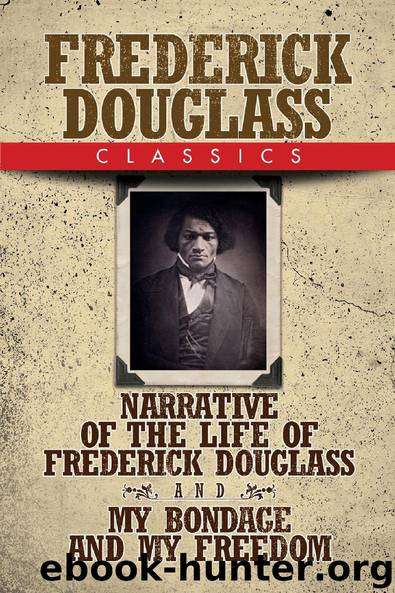
Frederick Douglass Classics: Narrative of the Life of Frederick Douglass and My Bondage and My Freedom by Frederic Douglass
Author:Frederic Douglass
Language: eng
Format: epub
Publisher: G&D Media
Published: 2019-09-15T00:00:00+00:00
CHAPTER 14
Experience in St. Michael’s
The Village ♦ Its Inhabitants ♦ Their Occupation And Low Propensities Captain Thomas Auld ♦ His Character ♦ His Second Wife, Rowena ♦ Well Matched ♦ Sufferings From Hunger ♦ Obliged To Take Food ♦ Mode Of Argument In Vindication Thereof ♦ No Moral Code Of Free Society Can Apply To Slave Society ♦ Southern Camp Meeting ♦ What Master Thomas Did There ♦ Hopes ♦ Suspicions About His Conversion ♦ The Result ♦ Faith And Works Entirely At Variance ♦ His Rise And Progress In The Church ♦ Poor Cousin “Henny” ♦ His Treatment Of Her ♦ The Methodist Preachers ♦ Their Utter Disregard Of Us—One Excellent Exception ♦ Rev. George Cookman ♦ Sabbath School ♦ How Broken Up And By Whom ♦ A Funeral Pall Cast Over All My Prospects ♦ Covey The Negro-Breaker.
St. Michael’s, the village in which was now my new home, compared favorably with villages in slave states, generally. There were a few comfortable dwellings in it, but the place, as a whole, wore a dull, slovenly, enterprise-forsaken aspect. The mass of the buildings were wood; they had never enjoyed the artificial adornment of paint, and time and storms had worn off the bright color of the wood, leaving them almost as black as buildings charred by a conflagration.
St. Michael’s had, in former years, (previous to 1833, for that was the year I went to reside there,) enjoyed some reputation as a ship building community, but that business had almost entirely given place to oyster fishing, for the Baltimore and Philadelphia markets—a course of life highly unfavorable to morals, industry, and manners. Miles river was broad, and its oyster fishing grounds were extensive; and the fishermen were out, often, all day, and a part of the night, during autumn, winter and spring. This exposure was an excuse for carrying with them, in considerable quanties (sic), spirituous liquors, the then supposed best antidote for cold. Each canoe was supplied with its jug of rum; and tippling, among this class of the citizens of St. Michael’s, became general. This drinking habit, in an ignorant population, fostered coarseness, vulgarity and an indolent disregard for the social improvement of the place, so that it was admitted, by the few sober, thinking people who remained there, that St. Michael’s had become a very unsaintly, as well as unsightly place, before I went there to reside.
I left Baltimore for St. Michael’s in the month of March, 1833. I know the year, because it was the one succeeding the first cholera in Baltimore, and was the year, also, of that strange phenomenon, when the heavens seemed about to part with its starry train. I witnessed this gorgeous spectacle, and was awe-struck. The air seemed filled with bright, descending messengers from the sky. It was about daybreak when I saw this sublime scene. I was not without the suggestion, at the moment, that it might be the harbinger of the coming of the Son of Man; and, in my then state of mind, I was prepared to hail Him as my friend and deliverer.
Download
This site does not store any files on its server. We only index and link to content provided by other sites. Please contact the content providers to delete copyright contents if any and email us, we'll remove relevant links or contents immediately.
Still Foolin’ ’Em by Billy Crystal(36359)
We're Going to Need More Wine by Gabrielle Union(19046)
Plagued by Fire by Paul Hendrickson(17412)
Pimp by Iceberg Slim(14508)
Molly's Game by Molly Bloom(14145)
Becoming by Michelle Obama(10027)
When Breath Becomes Air by Paul Kalanithi(8447)
Educated by Tara Westover(8054)
The Girl Without a Voice by Casey Watson(7889)
The Incest Diary by Anonymous(7699)
Note to Self by Connor Franta(7671)
How to Be a Bawse: A Guide to Conquering Life by Lilly Singh(7486)
The Space Between by Michelle L. Teichman(6941)
What Does This Button Do? by Bruce Dickinson(6207)
Imperfect by Sanjay Manjrekar(5878)
Permanent Record by Edward Snowden(5847)
A Year in the Merde by Stephen Clarke(5430)
Shoe Dog by Phil Knight(5269)
Promise Me, Dad by Joe Biden(5153)
